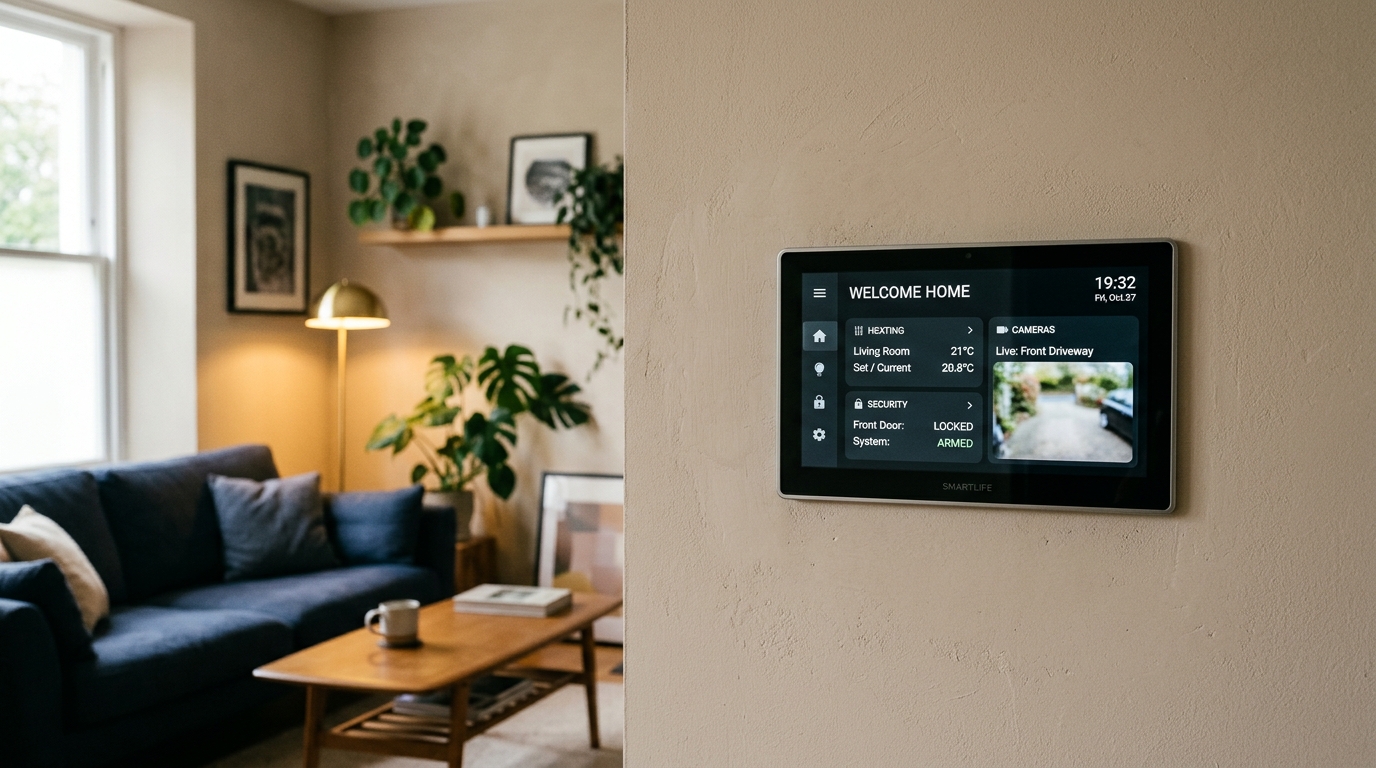
If your UK home has accumulated multiple smart gadgets—such as Ring doorbells, Philips Hue lighting, Hive or Tado thermostats, and Yale smart locks—relying on smartphones or shouting across rooms quickly causes friction for partners, guests, and children. The Amazon Echo Hub (£169.99) is the first purpose-built, wall-mounted Alexa panel that solves this cleanly: it features zero cameras for complete privacy, instant infrared proximity wake-up, responsive touch widgets, and built-in Matter/Thread/Zigbee radio hubs. For most British households looking for a unified communal dashboard without DIY complex wiring, it is the best off-the-shelf control station available today.
The App Clutter Problem: Why Voice & Smartphones Aren't Enough
Smart homes frequently start innocently: a smart video doorbell to catch Amazon parcels, two smart radiator valves to tame gas bills, a couple of smart bulbs in the hallway, and a robot vacuum under the sideboard. But within a year, the setup turns into a digital chore.
To turn on living room mood lighting or see who buzzed the front door, you have to find your phone, unlock it, locate the correct vendor app, wait for cloud servers to handshake, and tap a slider. When family members or guests visit, they are essentially locked out of your smart home unless you configure shared app accounts or train them on precise voice syntax.
Dedicated wall-mounted control panels have historically been the preserve of expensive bespoke custom installations (like Crestron or Control4) costing thousands of pounds, or DIY tablet mounts powered by Home Assistant requiring server hosting and custom 3D-printed faceplates. Consumer-grade smart displays like the Echo Show 8 improved accessibility, but brought their own annoyances: bulky desk stands, sponsored recipe cards, rotating news headlines, and intrusive cameras that make householders uneasy in central living spaces.
Amazon Echo Hub Deep Dive: Purpose-Built for Home Control
The Amazon Echo Hub directly targets these frustrations. Unlike traditional Echo Show displays that attempt to be kitchen TVs and photo reels first, the Echo Hub is fundamentally a dedicated wall controller.
Measuring just 15mm deep with an 8-inch 1280x800 display, it sits remarkably flush against the wall. Several engineering choices make it substantially better suited for communal hallways and kitchens than standard smart speakers:
Key Advantages for UK Homeowners:
- Zero Cameras for True Privacy: Unlike the Echo Show 8 or 10, the Echo Hub has no camera whatsoever. You can mount it outside the bathroom, in the main hallway, or in private family spaces without privacy concerns or mechanical privacy shutters.
- Infrared Proximity Sensor: Using passive infrared detection, the screen stays dim and clean with a discreet clock when the room is empty, then instantly springs to life with your smart home dashboard the second anyone steps within 1.5 metres.
- Customisable Widget Grid: You can pin fast action tiles for your most-used routines: "Lock All Doors", "Arm Ring Alarm", "Living Room Movie Scene", or live multi-camera camera grids (up to 4 Ring or Blink feeds simultaneously).
- Minimal Sponsored Distractions: Because it runs dedicated smart home dashboard software rather than the standard Echo Show carousel, you are spared irrelevant sponsored recipes and celebrity gossip.
Mounting & Powering in British Homes
In North America, hollow stud walls are standard everywhere. In the UK, however, downstairs hallways and external walls in Victorian, 1930s semis, and modern new-builds often feature solid brick, thermalite breeze block, or dot-and-dab plasterboard. How practical is mounting an Echo Hub?
Option A: Surface-Mounted with Included Slimline Bracket
Amazon includes a low-profile metal wall bracket and rawlplugs in the box. Screwing the bracket into a standard UK plasterboard wall takes five minutes. The included 1.8-metre white USB-C cable runs neatly down to a standard 13A UK mains plug. For a tidy aesthetic, white self-adhesive micro trunking (available from Screwfix or B&Q for under £6) hides the cable flush against skirting boards.
Option B: Clean In-Wall Cable Routing & Recessed Boxes
If you have stud partition walls (common in modern UK upstairs landings or interior divide walls), you can cut a single-gang opening behind the mount, drop the USB-C cable through the cavity, and plug it into a hidden fused spur or low-level socket. The Echo Hub requires standard 5V/2.5A (12.5W) USB-C power.
Option C: Power-over-Ethernet (PoE)
For tech-savvy homeowners with structured Cat6 network cabling running throughout the home, the Echo Hub supports third-party USB-C PoE adapters. A single network cable delivers both rock-solid gigabit data connectivity and DC power without needing an AC mains socket nearby.
Matter, Thread & Zigbee: Local Speed vs Cloud Latency
One of the Echo Hub's strongest technical features is its integrated radio array. Inside the slim 15mm chassis sits:
- Thread Border Router: Directly routes mesh packets for next-gen Thread smart accessories (such as Nanoleaf, Eve sensors, and Aqara U200 smart locks).
- Zigbee Hub: Directly pairs with Zigbee bulbs and sensors (like Philips Hue and Ikea Trådfri) without needing separate proprietary bridges.
- Matter Controller: Handles universal smart home cross-compatibility across iOS, Android, and Alexa.
- Bluetooth Low Energy (BLE): Handles local mesh tracking and device provisioning.
In everyday use, having the Thread Border Router and Zigbee controller right on your wall reduces the latency of light switches and lock toggles from 1.5–2 seconds down to near-instant sub-second execution, because commands do not need to journey to Amazon's cloud servers and back.
Echo Hub vs Echo Show 8 vs Google Nest Hub
How does the Echo Hub compare against the most popular smart displays currently sold in the UK? Review the side-by-side comparison below:
| Feature | Amazon Echo Hub | Amazon Echo Show 8 (3rd Gen) | Google Nest Hub (2nd Gen) |
|---|---|---|---|
| Primary Purpose | Dedicated Wall Hub | Countertop Media & Calls | Bedside & Kitchen Display |
| UK Retail Price | £169.99 | £149.99 | £89.99 |
| Screen Size | 8.0" (1280x800) | 8.0" (1280x800) | 7.0" (1024x600) |
| Form Factor | Ultra-slim wall mount (15mm) | Bulky desktop wedge with stand | Fixed desktop pedestal |
| Built-in Camera | None (Total Privacy) | 13MP Auto-framing | None (Radar Sleep Sensing) |
| Smart Radios | Matter, Thread, Zigbee, BLE | Matter, Thread, Zigbee, BLE | Matter over Wi-Fi, BLE |
| Audio Quality | Basic speech/feedback speakers | Spatial Audio with bass radiators | Decent tabletop speaker |
The Final UK Verdict: Should You Buy It?
The Amazon Echo Hub is not a device designed for casual smart speaker owners with a single Echo Dot in the kitchen. If all you do is play BBC Radio 4 or ask for morning weather forecasts, an Echo Dot or Echo Show 8 offers better audio at a lower price.
However, if you have invested in British smart home essentials—Ring video doorbells, smart TRVs (like Tado or Hive), smart door locks, and multi-room lighting—the Echo Hub delivers exactly what was missing: a permanent, communal, camera-free master dashboard that anyone in your home can operate without thinking twice.
Who Should Buy the Echo Hub:
- Households with Ring or Blink Doorbells: Instant, lag-free live video answering right on the wall.
- Multi-Brand Smart Homes: Users wanting local Matter and Zigbee control without needing 3 different bridge boxes plugged into their router.
- Privacy-Conscious Buyers: Perfect for hallways, landings, and bedrooms where you explicitly do not want a video camera lens.
Product specifications, UK retail pricing (£169.99), and compatibility verified November 2026. Always confirm live pricing and shipping availability on Amazon UK before purchasing.
Explore More Useful AI Gadgets
Browse our curated weekly directory of verified, practical AI hardware available to British buyers.
Browse the Full Catalog →